
Sept. 16
By Che Pan, Casey Hall and Eduardo Baptista
Huawei Technologies will launch two new artificial-intelligence semiconductors in 2027, rotating chairman David Wang said on Thursday, as the Chinese tech giant builds up its AI computing business and seeks to challenge U.S. chipmaker Nvidia.
Huawei plans to launch the 960DT in the first quarter of 2027 and the Ascend 960PR in the third quarter, Wang said.
The company is also working on ways to connect very large numbers of AI chips, allowing them to work together as one bigger computing system. Most advanced AI programmes require more processing power than a single chip can provide.
Wang said in a speech at a company even in Shanghai that Huawei’s UnifiedBus technology would be a key link in the company’s next generation of large AI systems. The technology is intended to help chips share information and work together more efficiently.
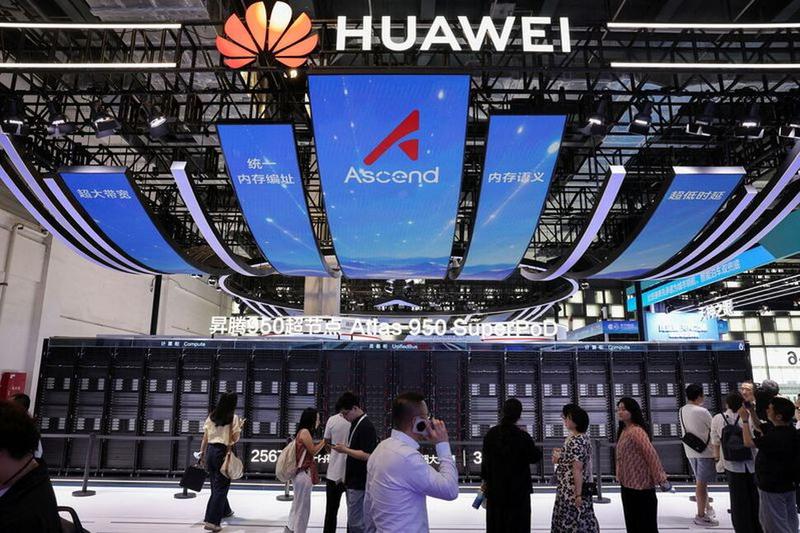
Huawei has developed 11 semiconductors based on UnifiedBus technology for use in its large systems, Wang said. Its largest linked systems, which the company calls superclusters, can support up to 1 million AI processors, he added.
Huawei has shipped more than 1,000 smaller linked systems, called supernodes, to more than 370 customers, Wang said. A supernode is a system that brings together many AI chips to tackle the same task. Wang did not say how many chips could be connected within a single supernode, name customers, or give a breakdown of shipments.
HUAWEI PART OF CHINA’S AI PUSH
The United States and China are competing to develop the chips, data centres and software that underpin artificial intelligence.
Washington has imposed export controls that restrict China’s access to certain advanced computing chips and semiconductor manufacturing equipment, while Chinese companies and policymakers have placed greater emphasis on building domestic alternatives.
That has made the ability to connect chips increasingly important for Chinese technology companies.
If they cannot freely buy the most advanced foreign chips, they can seek more computing power by joining larger numbers of locally available chips in one system. But that approach only works well if the chips can exchange information quickly enough.
U.S. export controls have helped Huawei emerge as a prominent Chinese supplier of AI chips. Still, it faces a well-established market leader in Nvidia, whose hardware and software tools are widely used by developers around the world.
A strong developer base will be important to Huawei’s effort to make its hardware easier to use. Wang said Huawei’s AI chip ecosystem had 5,270 monthly active developers.